

Three identical measuring tapes tossed into the wrong toolbox. Work jackets mixed up after laundry. Small mix-ups like these happen all the time in busy workplaces. And while each one seems minor on its own, together they waste time and make everyday workflows more chaotic than they need to be.
That’s why many teams use a tool labeling system to keep equipment organized and make it immediately clear which team, department, or employee it belongs to.
In this guide, we’ll look at practical ways to build an efficient tool labeling system, what information is actually useful on labels, and how different label types can help organize everyday work environments more efficiently.
Why a Labeling System Saves More Than Just Time
When equipment is clearly labeled, people spend less time searching and asking questions. New employees can quickly figure out which shelves, lockers, tools, or storage areas belong to their team, and shared equipment is far less likely to end up in the wrong truck, department, or storage area.
Clear labeling also helps workplaces stay flexible. On construction crews, maintenance teams, or cleaning staff, tools and supplies often move between vehicles, storage rooms, and employees throughout the day. New tools arrive, teams change, storage areas get reorganized—and a practical labeling system can easily adapt without creating extra work.

What Information Should Be Included in a Tool Labeling System?
The best tool labels make equipment easy to identify at a glance. What information makes sense depends largely on how the equipment is used and whether it stays with one person or moves between teams, departments, or locations.
For personal tools, a first name and phone number are often enough. In larger teams or shared environments, adding a last name, department, or company name can make organization much easier.
For uniforms or work clothing, many companies prefer labels that include both the employee’s name and their role or department. A simple setup like:
- Michael R.
- Company name
or:
- Emma
- Housekeeping
- Ext. 204
can make day-to-day organization much easier.
When creating custom labels, it’s usually better to split information across multiple lines instead of cramming everything into one row. This keeps the text larger, cleaner, and easier to read at a glance.
Many label systems—including ours—allow multiple text lines to be added. One line might display a first name, while the remaining lines include a phone number, department, or company name. This often creates a far more professional and practical result than trying to fit too much information into a single line of text.
The key is to keep labels easy to read and consistent across the entire system.
Color Coding Makes Organization Easier
A good labeling system doesn’t always need more text. Sometimes, color alone can make organization much faster and more intuitive.
Color coding is especially useful in shared environments. Instead of checking labels one by one, employees can immediately recognize where equipment belongs just by the color.
Some companies assign specific colors to work areas. A maintenance team might use blue labels, while housekeeping uses red and logistics uses green. Schools, maintenance departments, and local government facilities often use the same system for shared equipment.
This approach also works well in offices. Colored labels can help organize filing systems, storage cabinets, rolling carts, or shared office equipment.
Which Label Types Work in a Tool Labeling System?
Standard-sized name labels are often the most versatile option for workplaces. Most only require a clean, smooth surface and work well on many everyday items. Because they also allow multiple lines of text, they’re especially useful when names, departments, or company details need to stay easy to read.
The same size is also commonly used for uniforms and work clothing. Stick-on labels can be applied directly to synthetic clothing tags inside uniforms or jackets, while iron-on labels are a great option when garments don’t have suitable care labels.
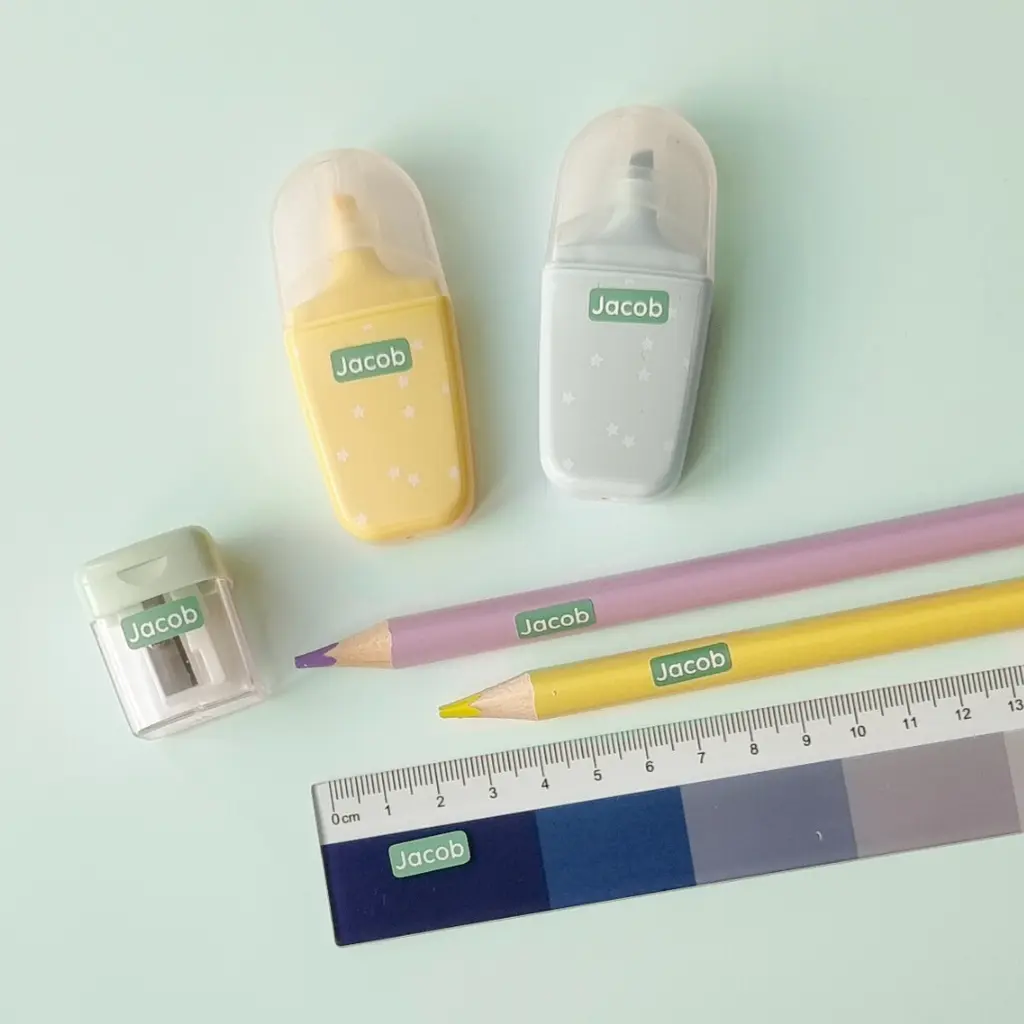
For smaller or narrow items, compact labels often work better. Mini labels and slim pencil labels are useful for smoother surfaces with limited space, such as measuring tools, office supplies, or chargers.
In larger organizations, many teams prefer using one consistent label type across most equipment to keep the system visually clean and easy to manage. Others combine several sizes depending on the application, creating a system that stays organized without becoming difficult to manage.
A Simple System That Grows With Your Workflow
An effective labeling system doesn’t need to be complicated. The best setups are usually the easiest to maintain and understand across the entire team.
Explore our full collection of custom labels to build a tool labeling system that fits your workflow and team.


